The demenz balance-Modell©
Experiential Learning as a Pathway to Person-Centred Dementia Care
The demenz balance-Modell© is an experiential learning approach developed by Barbara Klee-Reiter. Grounded in Tom Kitwood’s person-centred approach, it helps dementia care professionals and family caregivers explore the relationship between personal resources, psychological needs and supportive relationships.
Through guided self-experience, participants explore how the symbolic loss of personal resources affects their sense of identity, well-being and balance. They discover how external support becomes increasingly important when personal resources are no longer sufficient to maintain a sense of balance.
The model does not attempt to simulate the experience of living with dementia. Instead, structured reflection helps participants transfer insights from their personal experiences to a deeper understanding of person-centred dementia care.
How does the model work?
The self-experience process follows three stages:
1. THIS IS ME – Recognising personal resources
Participants identify the personal resources that shape their identity, contribute to their well-being and help them maintain a sense of balance.
2. LOSING BALANCE – Experiencing the loss of personal resources
Step by step, participants’ personal resources are symbolically taken away. As personal resources decrease, maintaining balance becomes increasingly difficult through one’s own resources alone.
3. REGAINING BALANCE – Experiencing external support
Participants identify the support they need to regain balance. As personal resources decrease, compensatory support from the social environment becomes increasingly important.
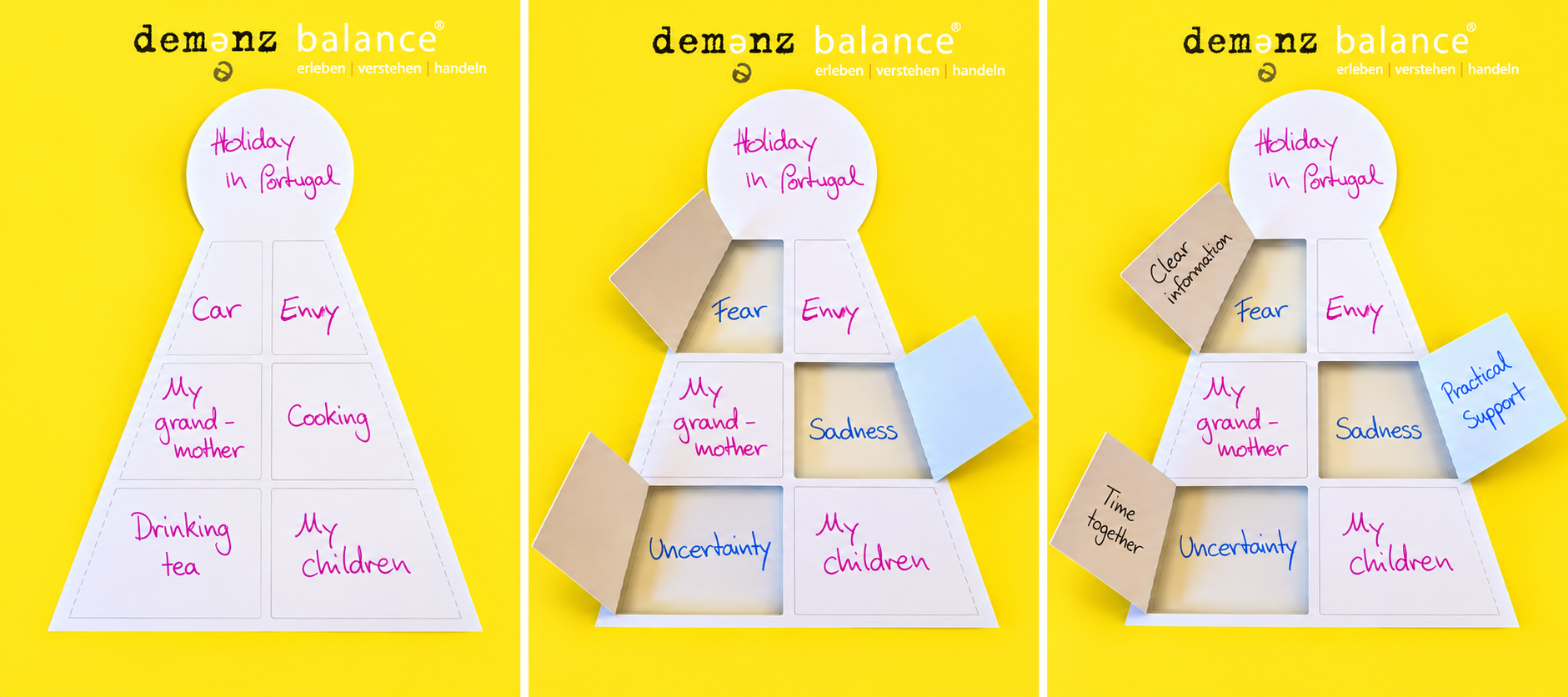
The three stages of the demenz balance-Modell©: recognising personal resources, experiencing their loss and exploring the importance of external support.
From Self-Experience to Person-Centred Practice
The experiential process is followed by structured reflection. Participants explore how their personal experiences of losing resources and receiving support relate to the psychological needs of people living with dementia.
For dementia care professionals, this reflection provides an opportunity to connect personal insights with professional knowledge and practice. It encourages a person-centred approach that recognises the importance of supportive relationships, individual needs and the social environment.
Scientific Poster – Alzheimer Europe Conference 2026
The demenz balance-Modell©: Experiential Learning as a Pathway to a Person-Centred Approach in Dementia Care
Our scientific poster introduces the theoretical foundations and experiential learning process of the demenz balance-Modell©. It highlights how guided self-experience and structured reflection can contribute to a deeper understanding of person-centred dementia care.
Presented at the 36th Alzheimer Europe Conference in Dublin, Ireland, 27–29 October 2026.
Authors: Anna Reiter and Barbara Klee-Reiter
Affiliation: perspektive-demenz, Germany
Poster number: POS24-03
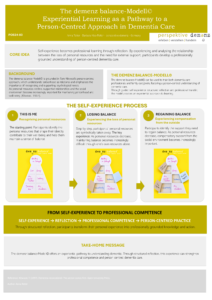
View or download the scientific poster (PDF)
Training and Contact
The demenz balance-Modell© is used in educational and training settings for dementia care professionals and family caregivers. It offers an opportunity to explore the importance of personal resources, psychological needs and supportive relationships through guided self-experience and structured reflection.
perspektive-demenz offers training opportunities and further information about the model.
For enquiries about training, the demenz balance-Modell© or potential international collaboration, please contact:
Anna Reiter
perspektive-demenz · Germany
Email: reiter@perspektive-demenz.de
Further information in German: https://perspektive-demenz.de/demenz-balance-modell/